
Best price
Filter inCategory
Too much choice?
Find the product in 3 steps!
Help me choose!
Current refinements:
Only in Stock
Brand
Dimmable
Explanation
Dimmable bulbs work in combination with a dimmer switch and allow you to determine the desired light output. Dimming also provides energy saving potential because less power is required when the lamp is producing less light.
Shape
Cap / Base
Explanation
The cap/base of a bulb is the part that connects it to the socket in the fixture. E27 (Edison screw) and E24 (small Edison screw) caps/bases are among the most popular, although this depends on your location. GU10 is generally the most common cap/base for spotlights. Check which cap/base you need carefully as many other types are also available.
Colour Code
Explanation The colour code is a combination of colour rendering (CRI) and light colour (Kelvin). The first number indicates the colour rendering (1 = very poor colour rendering, 9 = maximum colour fastness). The second and third number contains the light colour. Example: the colour code 830 consists of good colour rendering (8) and warm white light (3000K).
The colour code is a combination of colour rendering (CRI) and light colour (Kelvin). The first number indicates the colour rendering (1 = very poor colour rendering, 9 = maximum colour fastness). The second and third number contains the light colour. Example: the colour code 830 consists of good colour rendering (8) and warm white light (3000K).
Colour temperature (Kelvin)
Explanation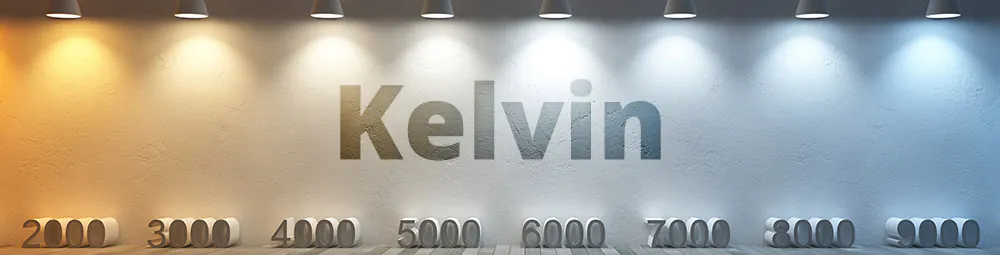
Light colour options
Explanation
The colour control type tells you in which way you can regulate the colour of the light. You have the following options:
1. Single colour: This light has one fixed light colour. You cannot change it.
2. CCT: You choose from 2 or 3 fixed colours via a switch, such as warm white or cool white.
3. Tunable white: The white light can take any values in the listed Kelvin scale, for instance 2200K up to 6500K.
4. Dim to warm: Dimming makes the light warmer (more yellow). The more you dim, the warmer the colour.
5. RGB: You can set the light to almost any colour. From red to blue, you fill it in completely as you wish.
By choosing your preferred light colour options, you are one step closer to the right light product.
Colour of Light
Explanation
The light color indicates the color of the light emitted: white, colored, or UV. For many products in our assortment, the light is white, available in a range from very warm white to daylight white (expressed in Kelvin). With colored light, you have two options: 1. A single fixed color, such as red or green. 2. RGBW, which means you can adjust the light color at any time: white or colored.
Voltage (V)
Explanation
Lighting with a voltage of 220-240 Volt can be connected directly to the mains. Lighting with a different mains voltage (12 Volt and 24 Volt) requires an (electronic) transformer.
Any Lamp all-in warranty
Explanation
Our all-in warranty is fully included in the product price and covers both hidden defects and technical defects of the product that occurred before delivery. The warranty period differs per product and ranges from 1 year to a maximum of 7 years.
Product Type Category
Explanation
This filter allows you to refine your search by selecting specific types of light sources. Choose from options such as LED bulbs, LED tubes, or LED spots to find the perfect lighting solution for your needs.
Wattage
Explanation
The wattage indicates how much energy a light source consumes. With LED lighting, the wattage is considerably lower than with conventional lighting. LED lamps with a higher wattage generally also have a higher light intensity (number of lumens).
Exact shape
Series
Beam Angle (degree)
Explanation
A beam angle indicates the angle of the light beam coming from a light source. The smaller the radiation angle in degrees (D), the narrower the beam angle.
Ballast for LED Tubes
Explanation
A ballast can be seen as an energy regulator that switches on the lighting. Is there a starter in the fixture? Then this is a conventional ballast (EM). Fixtures with an electronic ballast (HF) don't have a starter. A LED driver can be compared to an electronic ballast and only works with LED lighting.
Colour temperature (Kelvin)
Explanation
Colour Code
Explanation
The colour code is a combination of colour rendering (CRI) and light colour (Kelvin). The first number indicates the colour rendering (1 = very poor colour rendering, 9 = maximum colour fastness). The second and third number contains the light colour. Example: the colour code 830 consists of good colour rendering (8) and warm white light (3000K).
The colour code is a combination of colour rendering (CRI) and light colour (Kelvin). The first number indicates the colour rendering (1 = very poor colour rendering, 9 = maximum colour fastness). The second and third number contains the light colour. Example: the colour code 830 consists of good colour rendering (8) and warm white light (3000K).Show products
Too much choice?
Help me choose!
Current search
1-0 out of 0
results found
Filter
Sort by
